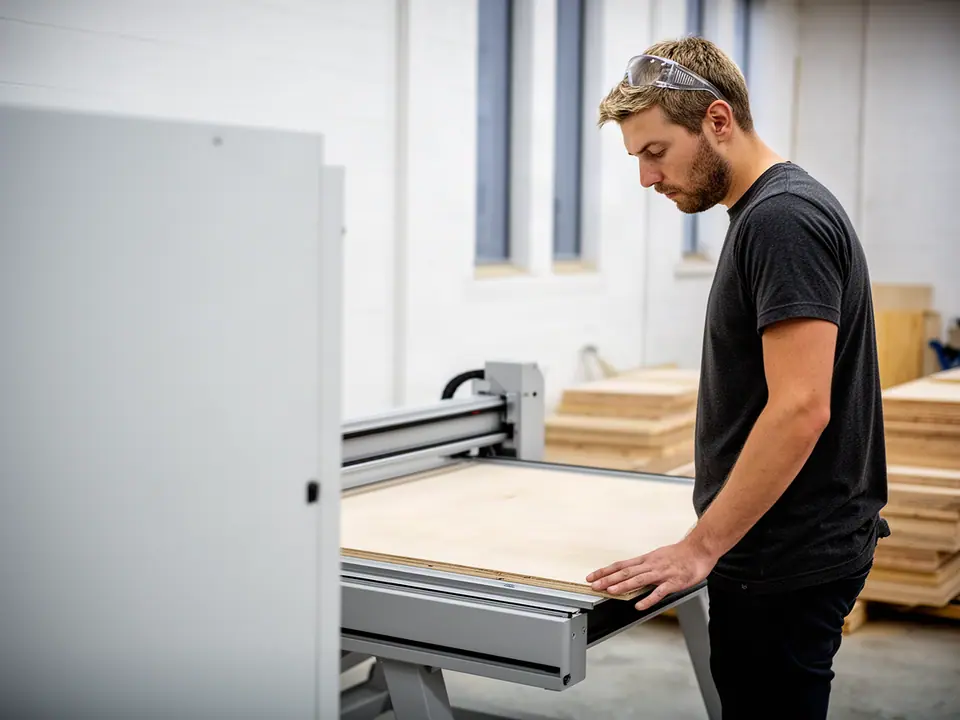
Goshen, IN plants use working capital to keep paying a trained crew when a customer’s orders stop for a few weeks or arrive late, and a working capital loan can bridge the part of that gap the plant’s own cash cannot. The invented cases below size one gap and read working capital off a balance sheet. A call to Frostpine Loans puts the plant in touch with funding partners, who set any terms.
A working capital loan pays day-to-day costs such as payroll over months, not machines over years. Size it to the worst case of the gap, the loan’s own first payment included. Working capital is current assets minus current liabilities; the invented woodworking shop’s balance sheet shows how to read it.
What is a working capital loan? An Elkhart County, IN home builder waiting on a client’s progress payment
A working capital loan is a single sum for day-to-day costs, such as payroll and materials, paid back in installments over months rather than years. It is not meant for a machine that lasts a decade.
In this invented case a home builder’s client pays a progress payment 28 days later than planned, while the framing crew’s weekly payroll of $7,215 keeps running. Any 28 days hold exactly four weekly paydays, so the invented gap is $28,860.
A six-month working capital loan for the invented $28,860 at 14.05% a year is paid back in six payments of $5,009.02. In this invented case the first one is due 30 days after funding, two days after the late payment arrives, and the six together come to $30,054.12, $1,194.12 of it interest.
How to get a working capital loan: what a Goshen, IN woodworking shop gathers before the call
A woodworking shop that makes cabinets and millwork can get its records in order before it calls, so the conversation is about the gap rather than missing paperwork:
- The last several months of business bank statements, with customer deposits marked
- A list of open orders with the dates each customer has said it expects to pay
- The payroll register for recent pay periods
- Any loans or leases already running, with their monthly payments
- A short note on what caused the gap and when it ends
After the call, a funding partner may review the statements, time in business and credit, and any offer names the amount, rate, term and payment schedule. The shop compares that schedule with the dates on its own list of open orders before it signs.
How to use a working capital loan when a Goshen, IN RV supplier’s orders stop for seven weeks
Illustration only, invented figures: an RV plant that buys from a Goshen, IN supplier pauses orders for 49 days while it changes a line. The supplier keeps its trained crew, whose biweekly payroll is an invented $16,380. Seven weeks of pause take in 3 paydays if the first one falls in the second week and 4 if it falls in the first week, so the invented payroll to cover runs from $49,140 to $65,520.
The supplier sets aside $21,000 of its own invented cash and sizes the loan to the worst case. A 12-month loan at 13.75% a year has its first payment inside the 49 days, so that payment belongs in the gap too. Together with that cash, an invented $49,000 covers the four paydays and the first payment of $4,393.81, and over 12 months the invented loan costs $52,725.72 in all.
If the orders return sooner, the supplier holds the unused part as a cushion and keeps paying on schedule. A supplier facing gaps like this every few months may find that a line of credit, drawn only for the weeks it needs, fits better.
Why is working capital important for a Goshen, IN woodworking shop? A balance-sheet check
On a woodworking shop’s balance sheet, working capital is the gap between two short-term totals: lumber, cash and customer invoices on one side, and supplier bills, wages owed and the year’s loan payments on the other. It shows whether the shop can meet the next months of bills from what it already has, which is also what a working capital assessment of a manufacturing company sets out to measure.
| Invented line | Current assets | Current liabilities |
|---|---|---|
| Cash in the bank | $41,300 | |
| Money customers owe | $186,900 | |
| Stock and material | $122,400 | |
| Current assets | $350,600 | |
| Supplier bills due | $97,800 | |
| Payroll earned, not yet paid | $32,760 | |
| Loan payments due within a year | $54,200 | |
| Credit line balance | $38,000 | |
| Current liabilities | $222,760 |
In this invented case working capital is $127,840 (our arithmetic). The current ratio, current assets divided by current liabilities, is 1.57, and leaving the stock out gives 1.02, so the invented shop covers its near-term bills even before its stock sells. A funding partner may look at these figures when it reviews a request.
Wood plants are a sizable employer group in the county. Elkhart County, IN counted 74 other wood product manufacturing establishments for 2023, the NAICS 3219 group that takes in millwork, with 3,383 employees (County Business Patterns). ZIP Code Business Patterns place seven other wood product establishments in ZIP 46526 (2023).
What is working capital used for in Elkhart County, IN plants? Uses beside payroll
Manufacturing carried the largest payroll of any sector in Elkhart County, IN, about $4.4 billion across 841 establishments in 2023 (County Business Patterns). Payroll is only one of the day-to-day costs that working capital pays for:
- Steel, aluminum or lumber bought for a confirmed order
- A repair bill on a machine that cannot wait for the next customer payment
- Insurance premiums billed in one sum
- Payroll taxes due with each payroll
- Utilities and rent between customer payments
Stock for one large order can also go on inventory financing, and the business loans page sets the funding types side by side. More cases are on the blog.
By Frostpine Loans · Updated